Check foundation and concealer in four passes: find the ingredient list for your own shade, scan the emollient base for esters and butters, note the format, and treat mineral pigments as a lower concern. Fulton found iron oxides and titanium dioxide were not a problem, while esters such as isopropyl myristate graded 5 [1].
Key takeaways
- In a 2025 case-control study of 151 people, the acne group used foundation (odds ratio 2.13) and powders (2.86) more often, and powder use was independently linked to a 3.47 times higher risk. The study was small and relied on self-reports [3].
- Fulton reported that iron oxides, chromium hydroxide, titanium dioxide, carmine, kaolin, bentonite and talc were not a problem in the rabbit ear [1].
- The base and the vehicle matter. D&C Red #36 graded 3 in mineral oil and 0 in PEG 400 [1].
- US labels can list color additives and ingredients at 1% or less in any order, and shade ranges may use 'may contain' or '+/-' for colors [2][4].
- A small 28-day pilot of an acne-targeted compact cream found it non-comedogenic in 20 women, but it was open-label and tiny [6].
Why does makeup need its own label check?
Makeup stays on the face for hours, and the research flags it. A 2025 case-control study in China found that foundation and powders were associated with higher acne risk, and that the association depended on exposure and ingredients [3]. A larger 2013 study found overall cosmetic use was inversely linked to post-adolescent acne, although some individual cosmetics had odds ratios above 1 [7].

So makeup in general is not the issue. Specific formulas may be. Fulton also noted that products beyond cleansers and moisturizers, including hair products and sunscreens, can be a source of cosmetic acne [1].
Step 1: Find the list for your own shade
Shade ranges share one label. In the US, ingredients at 1% or less and color additives may be declared in any order, and decorative products sold in several shades may list the whole range of colors with 'may contain' or '+/-' [2][4][5].
That means the colors at the end of the list may not all be in your shade. Read the ingredients in order up to the color section, then treat the color list as a menu of possibilities.
Step 2: Triage the base
The base is where most of the comedogenic risk sits in Fulton's data. Use this table to sort what you see.
| Category | Examples | Fulton's findings [1] |
| Mineral pigments and fillers | Iron oxides, titanium dioxide, chromium hydroxide, carmine, kaolin, bentonite, talc | Not a problem. Talc graded 1, kaolin and bentonite 0 |
| Higher-graded esters | Isopropyl myristate, isopropyl isostearate, myristyl myristate, isostearyl isostearate, ethylhexyl palmitate, stearyl heptanoate | Graded 4 to 5 |
| Lower-graded esters | Octyldodecyl stearate, diisopropyl adipate, cetyl palmitate, behenyl erucate | Graded 0 |
| Waxes | Candelilla, carnauba, ceresin, beeswax | Candelilla and carnauba 1, ceresin 0, beeswax 0 to 2 depending on source |
| Butters | Cocoa butter, coconut butter | Graded 4 |
| Vitamin E | Tocopherol and tocopheryl acetate | Tocopherol was a follicular irritant. Tocopheryl acetate was non-comedogenic |
| Sunscreen actives | The usual chemical sunscreen filters | Non-comedogenic |
| Cold-cream bases | Stearic acid with triethanolamine | Comedogenic at every ratio tested |
For the ingredients behind the higher grades, see the Comedogenic Ingredients List and How to Read an Ingredient List for Acne-Prone Skin. Fulton also noted that adding a metal such as zinc, lithium or magnesium to a fatty acid reduced its effect [1].
Step 3: Note the format
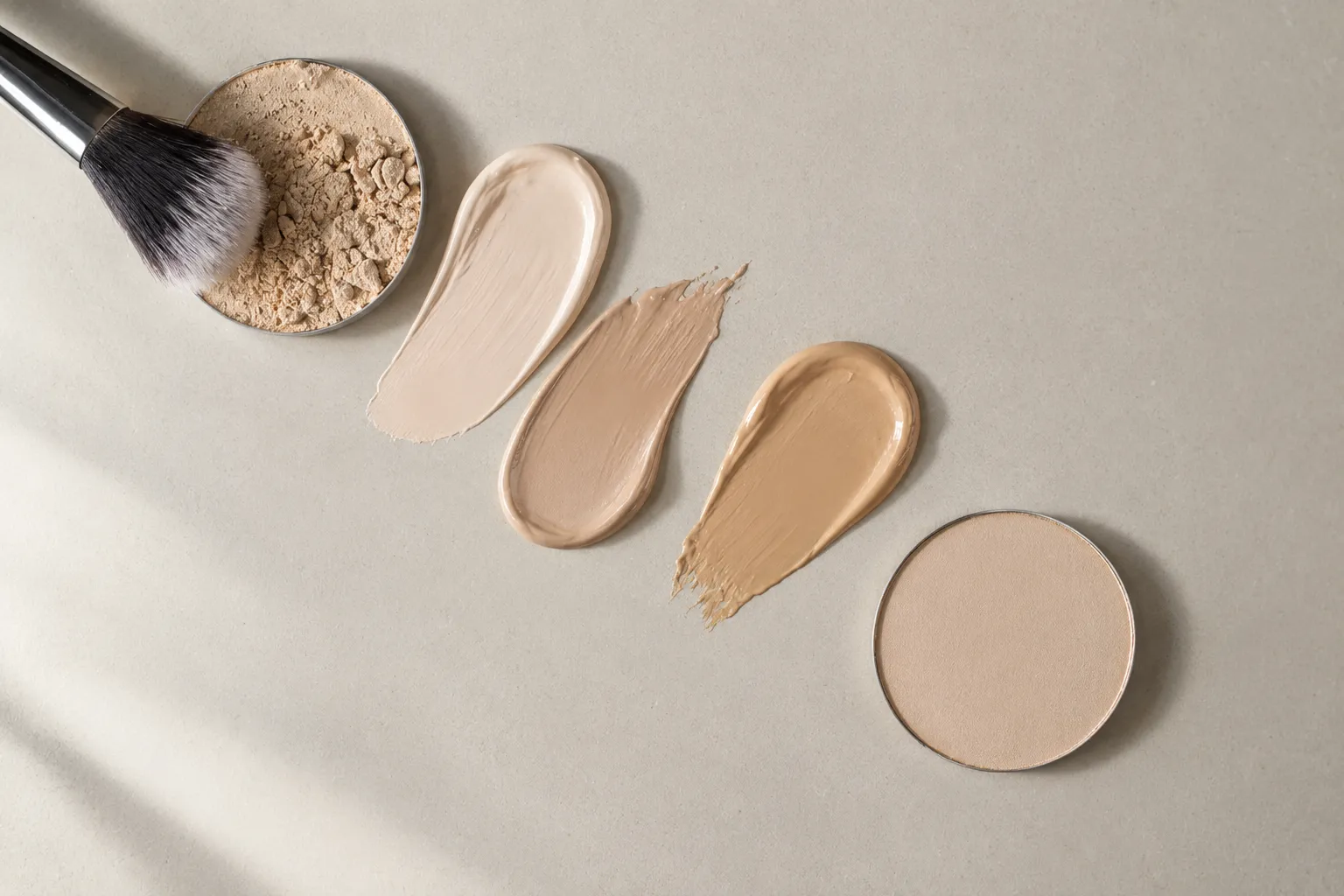
Fulton found that the vehicle can change a pigment's result. D&C Red #36 graded 3 in mineral oil, 2 in pentaerythrityl tetracaprate/caprylate, 1 in propylene glycol and 0 in PEG 400 [1]. He wrote that a dry compressed powder, or a powder suspended in an evaporating vehicle, may be non-comedogenic, while the same dye in a non-evaporating oil can be comedogenic [1].
That suggests the format deserves a second look. A formula built on oils and heavy esters deserves a closer read than a dry powder. Fulton tested individual ingredients and vehicles, not finished foundations, so treat this as a guide, not a rule.
Step 4: Check the extras
- SPF in the formula. The usual chemical sunscreen filters were non-comedogenic in Fulton's survey, so look at the rest of the formula [1].
- Vitamin E. Look for the exact name. Tocopherol was a follicular irritant, and tocopheryl acetate was not [1].
- Fragrance and 'may contain' colors. Neither shows what is in your shade or in what amount [2][4].
What does the evidence not show?
- Whole-product testing. The sources reviewed include one small pilot of a compact cream. It used 20 women over 28 days, was open-label, and found no comedogenicity and a 15.8% reduction in lesions. The formula was designed for acne, and the funding was not stated in the part reviewed [6].
- Foundation as a category. The 2025 and 2013 studies are associations, not proof that foundation causes acne [3][7].
- A guarantee from the label. Non-comedogenic is not regulated by any governing body [8].
- A finished product. A 2006 study found that finished products using comedogenic ingredients are not necessarily comedogenic [9]. See Non-Comedogenic vs Oil-Free.
Your five-minute checklist
- Find your shade's ingredient list. Ignore colors that are not in your shade.
- Scan the first ingredients for higher-graded esters and butters. Paste the list into the Klenzera scanner to speed this up.
- Note the format. Oil-based creams and sticks deserve a closer read than dry powders.
- Check position. See Does Ingredient Order Matter?.
- Test one product at a time. Use the steps in How to Know If a Product Will Clog Your Pores.
Frequently asked questions
Is mineral makeup non-comedogenic?
Iron oxides, titanium dioxide and similar minerals were not a problem in Fulton's survey [1]. But the finished product can include other ingredients, and the sources reviewed do not test mineral makeup as a category.
Is concealer different from foundation?
The method is the same. Check the base for esters and butters, and note that Fulton graded candelilla and carnauba wax 1, ceresin 0 and beeswax 0 to 2 depending on source [1].
Does non-comedogenic on the label mean it is safe for my skin?
No. The term is not regulated by any governing body [8].
Should I avoid every ester?
No. Some esters graded 4 to 5, but others, such as octyldodecyl stearate and diisopropyl adipate, graded 0 [1].
Why does my shade's label list so many colors?
US rules let makers list every color in a shade range with 'may contain' or '+/-' [4][5].
When should I see a dermatologist?
If breakouts are painful, cystic, scarring, persistent or suddenly worse, or if you suspect an allergic reaction, talk to a dermatologist or doctor.
The bottom line
Most of the risk in a foundation or concealer sits in the base, not in the mineral pigments. Read your own shade's list, look for the higher-graded esters and butters, and let your own skin decide.
This article is for educational and informational purposes only and is not dermatological diagnosis, medical treatment, or clinical advice. Talk to a licensed dermatologist about medical concerns.
Related reading: How to Know If a Product Will Clog Your Pores | How to Read an Ingredient List for Acne-Prone Skin | What Is Acne Cosmetica? | Is Isopropyl Myristate Comedogenic?
References
- Fulton JE Jr. Comedogenicity and irritancy of commonly used ingredients in skin care products. J Soc Cosmet Chem. 1989;40:321-333.
- US Food and Drug Administration. Summary of cosmetics labeling requirements. fda.gov/cosmetics/labeling-regulations/summary-labeling-requirements
- Dermatology Times. New insights on the link between comedogenic cosmetics and acne (summary of Choi K, Liu H, et al., Clin Cosmet Investig Dermatol, 2025). dermatologytimes.com/view/new-insights-on-the-link-between-comedogenic-cosmetics-and-acne
- 21 CFR 701.3: Designation of ingredients. ecfr.gov/current/title-21/chapter-I/subchapter-G/part-701/subpart-A/section-701.3
- Cosmetics & Toiletries. 'May contain' ingredient disclosures. cosmeticsandtoiletries.com/regulations/claims-labeling/blog/21837720/may-contain-ingredient-disclosures
- Tolerability and camouflaging effect of corrective make-up for acne: results of a clinical study of a novel face compact cream. Clin Cosmet Investig Dermatol. 2016. pmc.ncbi.nlm.nih.gov/articles/PMC5066693
- Acne cosmetica revisited: a case-control study shows a dose-dependent inverse association between overall cosmetic use and post-adolescent acne. Dermatology. 2013;226(4):337-341. doi:10.1159/000350936
- Clinical utility of marketing terms used for over-the-counter dermatologic products. J Dermatolog Treat. 2018;29(8):841-845. doi:10.1080/09546634.2018.1467540
- Draelos ZD, DiNardo JC. A re-evaluation of the comedogenicity concept. J Am Acad Dermatol. 2006;54(3):507-512. doi:10.1016/j.jaad.2005.11.1058