It may be, but the evidence is thinner than the familiar '4 out of 5' suggests. Fulton's 1989 rabbit-ear survey graded coconut butter 4, and a 2025 review reports that coconut oil produced microcomedones in rabbit skin [1][2]. The sources reviewed here include no human face trial of coconut oil as a pore-clogger.
Key takeaways
- Fulton graded coconut butter 4 and noted it has long been linked to pomade acne. Coconut oil is not listed separately in his table [1].
- A 2025 review reports that coconut oil produced microcomedones in rabbit skin [2].
- About 45% to 55% of coconut oil is lauric acid, which Fulton graded 4 as a free fatty acid. In the oil it is bound in triglycerides, so the grade does not transfer directly [1][4].
- Fractionated coconut oil keeps mainly caprylic and capric parts, and a related ingredient in Fulton's table graded 1 [1][5].
- No human face trial of coconut oil as a comedogen turned up in these sources, so treat the rating as a flag, not a verdict.
What is coconut oil in a product?
On a label, coconut oil appears as Cocos Nucifera Oil, sometimes written Cocos Nucifera (Coconut) Oil. It is mostly triglycerides, and lauric acid accounts for roughly 45% to 55% of it [4].
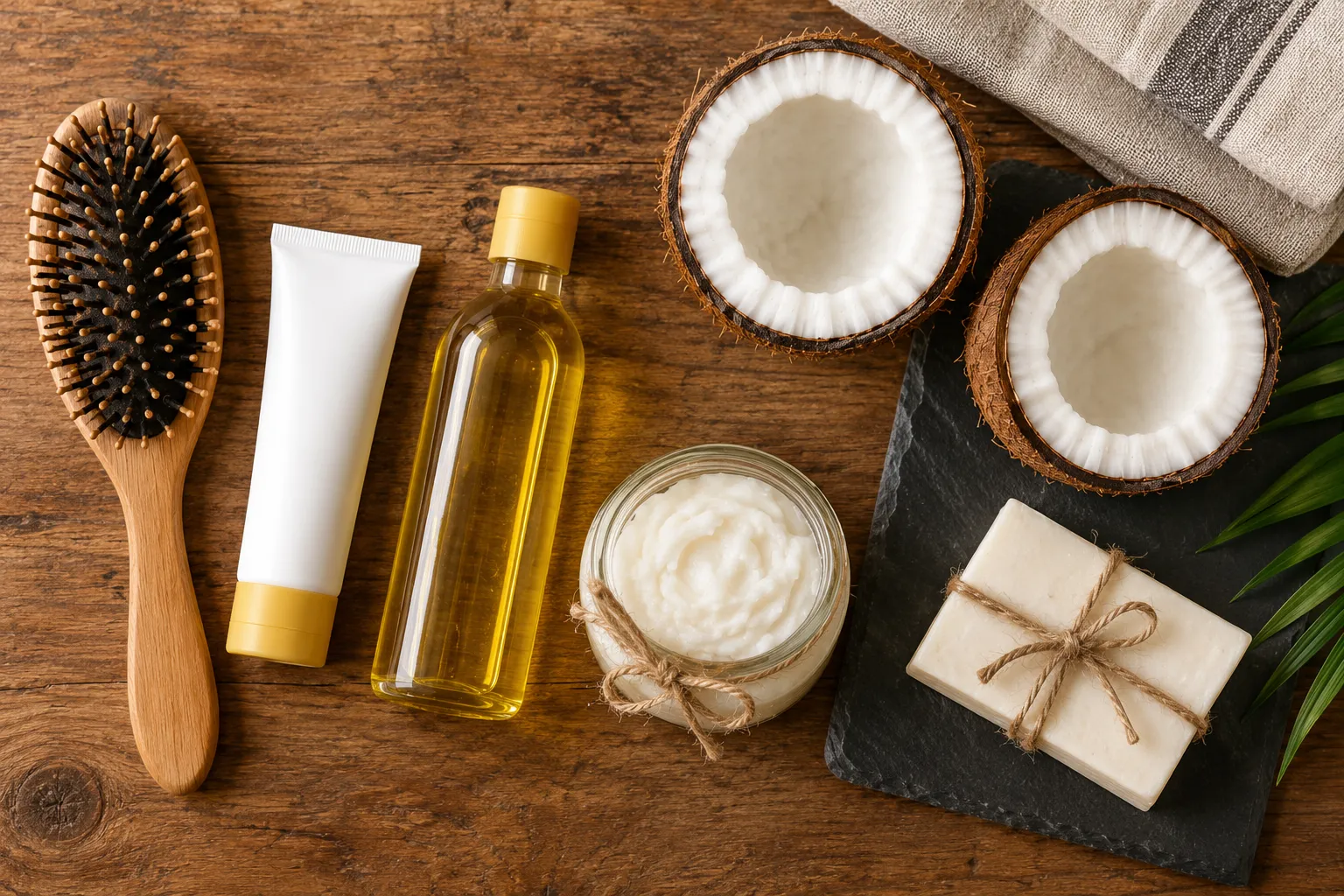
Variants exist. Fractionated coconut oil is a liquid version that keeps mainly the caprylic and capric parts [5]. Hydrogenated coconut oil is processed differently again.
What does the research show?
| Source | Finding |
| Fulton 1989 | Graded coconut butter 4 for comedogenicity and 0 for irritancy. Said coconut butter and cocoa butter have long been known to cause pomade acne, and that the rabbit ear confirms it. Coconut oil is not listed separately [1] |
| JAAD Reviews 2025 | Cocoa butter, coconut oil, wheat germ oil and apricot kernel oil produced microcomedones when applied to rabbit skin [2] |
| Dermatologist guidance | A dermatologist quoted by Cleveland Clinic generally does not recommend coconut oil on the face because it is highly comedogenic. This is clinical opinion, not trial data [3] |
The gap matters. The rabbit-ear evidence points the same way, but it is rabbit evidence, and the figure repeated online is a grade, not a human result.
Why might coconut oil clog pores?
The leading explanation is composition. Fulton noted that medium-chain fatty acids, such as lauric and myristic acid, were more potent than shorter or longer chains [1]. Coconut oil is rich in exactly those.
| Ingredient in Fulton's table | Comedogenic grade |
| Lauric acid | 4 |
| Myristic acid | 3 |
| Capric acid | 2 |
| Caprylic acid | 1 |
| Glyceryl tricaprylo/caprate | 1 |
But free fatty acids are not the same as the oil. In coconut oil they are bound in triglycerides, and Fulton found that large esters such as behenyl erucate and cetyl palmitate were not a problem [1]. He also showed the vehicle matters: lauric acid graded 3 in a volatile solvent and 4 in sunflower oil [1]. So composition is a reasonable hypothesis, not a demonstrated cause.
Do refinement and type matter?
Fulton found that for some natural oils, such as sesame, avocado and mink oil, results improved with a more refined oil. He did not report a refined coconut oil [1].
Fractionated coconut oil removes most of the lauric acid, leaving mainly caprylic and capric parts [5]. In Fulton's table the related glyceryl tricaprylo/caprate graded 1 [1]. That suggests fractionated coconut oil may behave differently, but it is an inference from related ingredients, not a test of the oil itself.
What does the evidence not show?
- Human face data. The sources reviewed include no human face trial of coconut oil as a comedogen.
- A specific grade for coconut oil. Fulton lists coconut butter, not coconut oil, and does not say whether they are the same material [1].
- How a finished product behaves. A 2006 study found that finished products using comedogenic ingredients are not necessarily comedogenic [6].
- How much is too much. Fulton tested at 10% and was not convinced that lower concentrations are safe [1].
Where does it show up, and what should you do?
| Name on the label | What it is | Fulton's note |
| Cocos Nucifera Oil | Coconut oil | Not graded separately. Coconut butter graded 4 |
| Hydrogenated Coconut Oil | Processed coconut oil | Not graded |
| Caprylic/Capric Triglyceride | Fractionated coconut fraction | Related glyceryl tricaprylo/caprate graded 1 |
| Lauric Acid | Coconut's main fatty acid | 4 |
- Check your products. Paste an ingredient list into the Klenzera scanner to see whether coconut oil or its derivatives appear and where.
- Look at hair and leave-on products. Fulton linked coconut butter to pomade acne on the forehead and temples [1].
- Weigh position, then test. See Does Ingredient Order Matter? and How to Know If a Product Will Clog Your Pores.
Frequently asked questions
Is coconut oil the same as coconut butter?
Fulton's table lists coconut butter, and the sources reviewed do not say it is identical to coconut oil [1].
Is fractionated coconut oil safer?
Its main components graded lower in Fulton's table, but the oil itself was not tested there [1][5].
Is virgin coconut oil better than refined?
The sources reviewed do not test this. Fulton saw better results from refined versions of some other oils [1].
Does the 4 out of 5 rating mean it will break me out?
No. It is a rabbit-ear-based grade for an ingredient, and finished products can behave differently [1][6].
When should I see a dermatologist?
If breakouts are painful, cystic, scarring, persistent or suddenly worse, or if you suspect an allergic reaction, talk to a dermatologist or doctor.
The bottom line
Coconut oil has a reasonable case against it for acne-prone skin, but the case rests on rabbit data, composition and clinical opinion, not on a human trial. Treat it as a strong flag, check where it sits in a product, and let your own skin decide.
This article is for educational and informational purposes only and is not dermatological diagnosis, medical treatment, or clinical advice. Talk to a licensed dermatologist about medical concerns.
Related reading: Comedogenic Ingredients List | Is Isopropyl Myristate Comedogenic? | Are Comedogenic Ratings Reliable? | Does Ingredient Order Matter?
References
- Fulton JE Jr. Comedogenicity and irritancy of commonly used ingredients in skin care products. J Soc Cosmet Chem. 1989;40:321-333.
- Comedogenicity in cosmeceuticals: a review of clinical relevance, regulatory gaps, and future directions. JAAD Reviews. 2025.
- Cleveland Clinic. Should you use coconut oil on your skin? health.clevelandclinic.org/coconut-oil-for-skin
- Biomedical applications of lauric acid: a narrative review. PMC. pmc.ncbi.nlm.nih.gov/articles/PMC11260118/
- ScienceInsights. Is coconut oil comedogenic? What it does to your pores. scienceinsights.org/is-coconut-oil-comedogenic-what-it-does-to-your-pores/
- Draelos ZD, DiNardo JC. A re-evaluation of the comedogenicity concept. J Am Acad Dermatol. 2006;54(3):507-512. doi:10.1016/j.jaad.2005.11.1058