Read a sunscreen in two parts: the UV filters and the base. A 1982 study found that 14 of 29 sunscreens were comedogenic in rabbit ears, but the vehicles seemed responsible, not the UV absorbers, which tested non-comedogenic [1]. So check the inactive ingredients, and remember that US Drug Facts labels list them alphabetically, not by amount [3].
Key takeaways
- In the 1982 rabbit-ear study of 29 sunscreen formulations, 14 were comedogenic and UV exposure enhanced the effect. The vehicles, not the UV-absorbing compounds, seemed responsible [1].
- Fulton reported that the usual chemical sunscreen filters were non-comedogenic, titanium dioxide was not a problem, and zinc oxide graded 1 [2].
- Under FDA's Drug Facts rules, active ingredients carry a proportion, and inactive ingredients are listed alphabetically [3][4].
- Base ingredients vary widely. Glyceryl stearate graded 1 while glyceryl stearate SE graded 3, and steareth-2 graded 2 while steareth-100 graded 0 [2].
- The sources reviewed include no human trial isolating sunscreens as a comedogen, and nothing here is a reason to skip sun protection.
What are you reading on a sunscreen label?
In the US, sunscreens carry a Drug Facts label. The active ingredients, the UV filters, come first, and for products without discrete dosage units, the label states the proportion of each [4]. Everything else is an inactive ingredient, meaning any component other than an active ingredient [4].
That split is useful for acne-prone skin, because the research points at the second group.
What did the research find about filters and bases?
| Source | Finding |
| Mills and Kligman 1982 | Fourteen of 29 proprietary sunscreen formulations, including suntan promoters, were comedogenic on rabbit ears. UV exposure enhanced the effect. The vehicles, rather than the UV-absorbing compounds, seemed responsible. A sampling of UV absorbers was non-comedogenic [1] |
| Fulton 1989 | The usual chemical sunscreen filters were non-comedogenic. Titanium dioxide was not a problem. Zinc oxide graded 1, and metal stearates such as lithium, magnesium and zinc stearate graded 1 or 0 [2] |
The 1982 authors suggested that sunscreen acne may be a subtype of acne cosmetica [1]. See What Is Acne Cosmetica?.
Why does the base matter so much?
Fulton found that the vehicle can raise or lower a result. D&C Red #36 graded 3 in mineral oil and 0 in PEG 400 [2]. Combinations can also change a grade: glyceryl stearate with added stearate salt (glyceryl stearate SE) graded 3, while plain glyceryl stearate graded 1 [2].
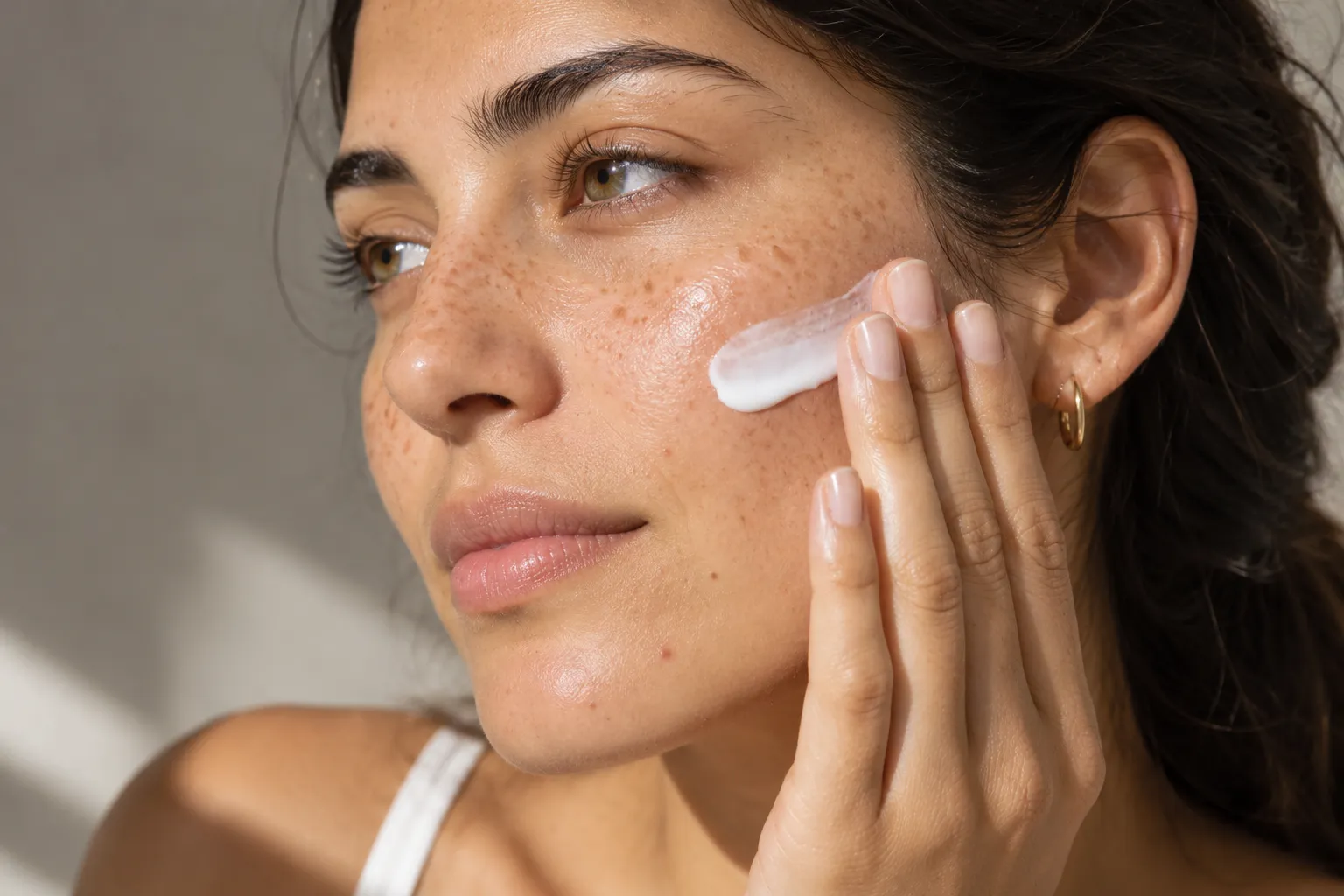
Those are the ingredients that make a lotion or cream feel the way it does, so a UV-filter list tells you little about pore risk.
Which base ingredients should you recognize?
These grades are from Fulton's 0 to 5 rabbit-ear scale, where 0 to 1 is not significant, 2 to 3 is borderline and 4 to 5 is positive [2].
| Ingredient | Grade |
| Glyceryl stearate (non-self-emulsifying) | 1 |
| Glyceryl stearate SE | 3 |
| PEG-100 stearate | 0 |
| Steareth-2 | 2 |
| Steareth-20 | 2 |
| Steareth-100 | 0 |
| Ceteareth-20 | 2 |
| Cetearyl alcohol | 2 |
| Stearic acid | 2 to 3, depending on source |
| Triethanolamine | 2 |
| Stearic acid with triethanolamine (cold-cream base) | 3 |
| Carbomer 940 | 1 |
| Glycerin, propylene glycol, sodium PCA | 0 |
| Isopropyl myristate | 5 |
| Isopropyl palmitate | 4 |
Naming traps apply here too. See How to Read an Ingredient List for Acne-Prone Skin.
How should you read the inactive list?
- Do not rely on position. FDA's Drug Facts rules list inactive ingredients in alphabetical order [3]. One sunscreen brand explains that a product that is both a sunscreen and a cosmetic may choose cosmetic-style order instead [5]. Either way, check which style your label uses before treating position as amount.
- Use the percentages for the actives only. Those percentages describe the UV filters, not the base [4].
- Look for the stronger flags in the base. Scan for esters, fatty acids, butters and the combinations in the table above. Paste the inactive list into the Klenzera scanner to speed this up.
- Test one product at a time. Use the steps in How to Know If a Product Will Clog Your Pores.

What does the evidence not show?
- Human data. The sources reviewed include no human trial isolating sunscreens as a comedogen, and the 1982 result is from rabbit ears [1].
- Which of the 29 formulas. The abstract does not name the products or their ingredients [1].
- A guarantee from the label. Non-comedogenic is not regulated by any governing body [7]. See Non-Comedogenic vs Oil-Free.
- A finished product. A 2006 study found that finished products using comedogenic ingredients are not necessarily comedogenic [6].
This article is about choosing a sunscreen, not about skipping one. If you are unsure which to use, ask a dermatologist.
Frequently asked questions
Are mineral sunscreens better for acne-prone skin?
In Fulton's data, titanium dioxide was not a problem and zinc oxide graded 1, while the usual chemical filters were also non-comedogenic [2]. The filter type was not the deciding factor in the studies reviewed. The base was.
Is an oil-free sunscreen safer?
Not necessarily. Kligman wrote that greasiness cannot be equated with comedogenicity [8]. See Non-Comedogenic vs Oil-Free.
Why are the inactive ingredients in alphabetical order?
FDA's Drug Facts rules for over-the-counter drugs call for it [3].
Should I skip sunscreen if I break out?
The studies reviewed are about choosing a formula, not about avoiding sunscreen. Talk to a dermatologist about options.
When should I see a dermatologist?
If breakouts are painful, cystic, scarring, persistent or suddenly worse, or if you suspect an allergic reaction, talk to a dermatologist or doctor.
The bottom line
For acne-prone skin, the useful question about a sunscreen is rarely which UV filter it uses. It is what the base is made of. Read the inactive list as a list of names, not amounts, and let your own skin decide.
This article is for educational and informational purposes only and is not dermatological diagnosis, medical treatment, or clinical advice. Talk to a licensed dermatologist about medical concerns.
Related reading: How to Check Foundation and Concealer for Pore-Clogging Ingredients | Does Ingredient Order Matter? | Comedogenic Ingredients List | What Is Acne Cosmetica?
References
- Mills OH Jr, Kligman AM. Comedogenicity of sunscreens: experimental observations in rabbits. Arch Dermatol. 1982;118(6):417-419. doi:10.1001/archderm.1982.01650180051016
- Fulton JE Jr. Comedogenicity and irritancy of commonly used ingredients in skin care products. J Soc Cosmet Chem. 1989;40:321-333.
- US Food and Drug Administration. The nonprescription Drug Facts label in a changing consumer marketplace (overview of Drug Facts labeling requirements). 2021. fda.gov/media/150101/download
- 21 CFR 201.66: Format and content requirements for over-the-counter drug product labeling. ecfr.gov/current/title-21/chapter-I/subchapter-C/part-201/subpart-C/section-201.66
- Brush On Block. Learn about the Drug Facts on your sunscreen. brushonblock.com/blogs/news/learn-about-the-drug-facts-on-your-sunscreen
- Draelos ZD, DiNardo JC. A re-evaluation of the comedogenicity concept. J Am Acad Dermatol. 2006;54(3):507-512. doi:10.1016/j.jaad.2005.11.1058
- Clinical utility of marketing terms used for over-the-counter dermatologic products. J Dermatolog Treat. 2018;29(8):841-845. doi:10.1080/09546634.2018.1467540
- Kligman AM. Petrolatum is not comedogenic in rabbits or humans: a critical reappraisal of the rabbit ear assay and the concept of 'acne cosmetica'. J Soc Cosmet Chem. 1996;47:41-48.